
How to Get More Google Reviews for Your Restaurant
You had a great service. Guests were happy. A table lingered over dessert, someone told you the pasta was the best they’d had in Melbourne, and a couple on their way out said they’d definitely be back.
Then nothing.
No review. No rating. Just a quiet profile sitting on Google Maps, waiting.
This happens in almost every restaurant I work with – and it’s not because guests don’t care. It’s not because they didn’t enjoy themselves. Most of the time, it’s simply because no one made it easy for them to leave a review at the right moment.
Most restaurants don’t have a review problem. They have a system problem.
And the good news is: a system is something you can fix.
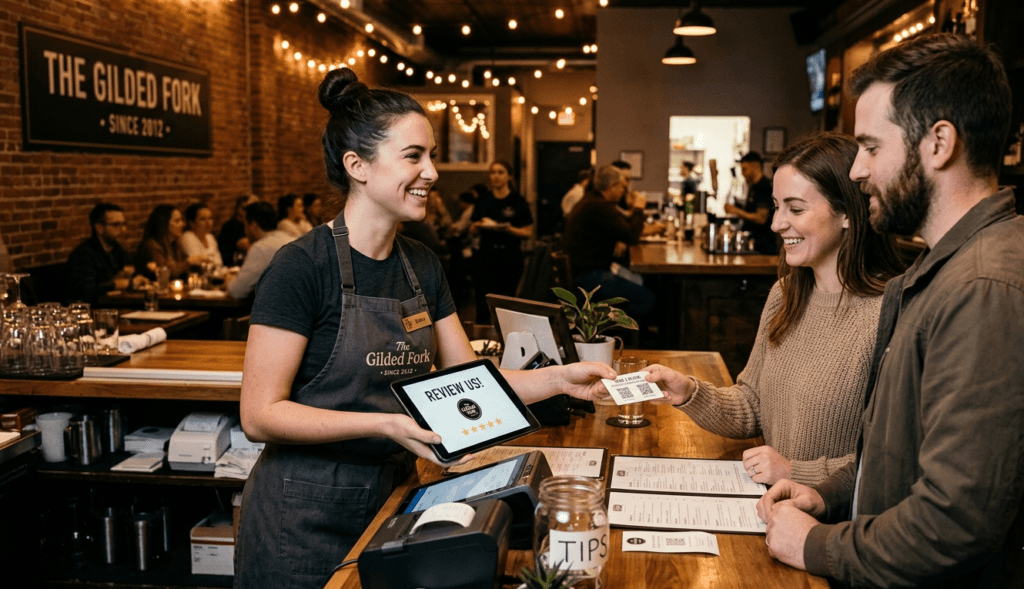
Why Google Reviews Matter for Restaurants
When someone is deciding where to eat tonight – or planning a weekend out – Google Maps is usually where that decision happens.
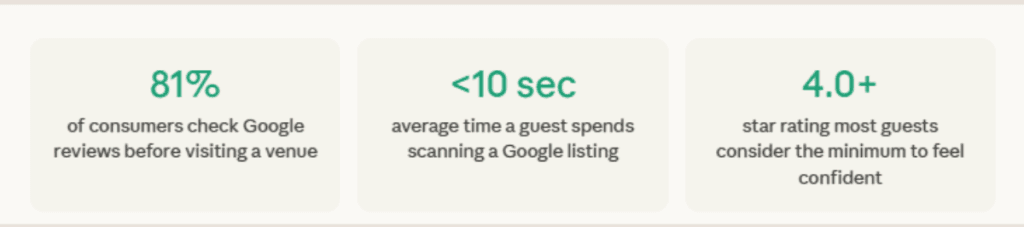
What guests are actually looking for:
⭐ Reviews that mention specific things – the food, the service, the vibe
⭐ A rating they can feel confident about (4.0 stars and above)
⭐ Enough reviews to feel like real evidence – not just a few friends
⭐ Recent reviews, that show the venue is still good right now
A venue with 200 reviews and a 4.6-star rating feels trustworthy. A venue with 18 reviews – and the most recent one from seven months ago – feels uncertain. Even if the food is genuinely excellent.
Reviews influence comparison. They reduce hesitation. And they quietly build the kind of confidence that makes a stranger choose your restaurant over the one next door.
That’s why getting more Google reviews matters – not as a vanity metric, but as a guest trust signal that works even when you’re in the middle of a busy dinner service.
Reviews are often the first thing guests notice – but they don’t exist on their own. They’re read alongside your photos and overall profile.
→ Read more: What Photos Work Best on Google Business Profile for Hospitality Venues
Why Most Restaurants Don’t Get Enough Google Reviews
Here’s what I notice when I start working with a restaurant: the experience is usually good. Often really good. But the profile doesn’t reflect that.
| The real reason | What it looks like |
|---|---|
| No system in place | Reviews come in when a guest is particularly motivated — or when something goes wrong |
| Staff are busy and asking feels awkward | The service team is focused on the table, not on marketing – so the moment passes |
| The timing is off | Asking when a guest is distracted, or mid-conversation means they forget by the time they’re home |
| Too much friction | If leaving a review requires multiple steps, most people won’t – not because they don’t want to, but because life gets in the way |
None of this is a criticism. It’s just the reality of running a restaurant. There’s never a quiet moment to build these systems, and it usually doesn’t feel urgent – until you notice that a nearby venue with half your quality has twice the reviews.
How to Get More Google Reviews for Your Restaurant
1. Make It Easy to Leave a Review
This is the most important thing. The simpler you make it, the more reviews you’ll get.
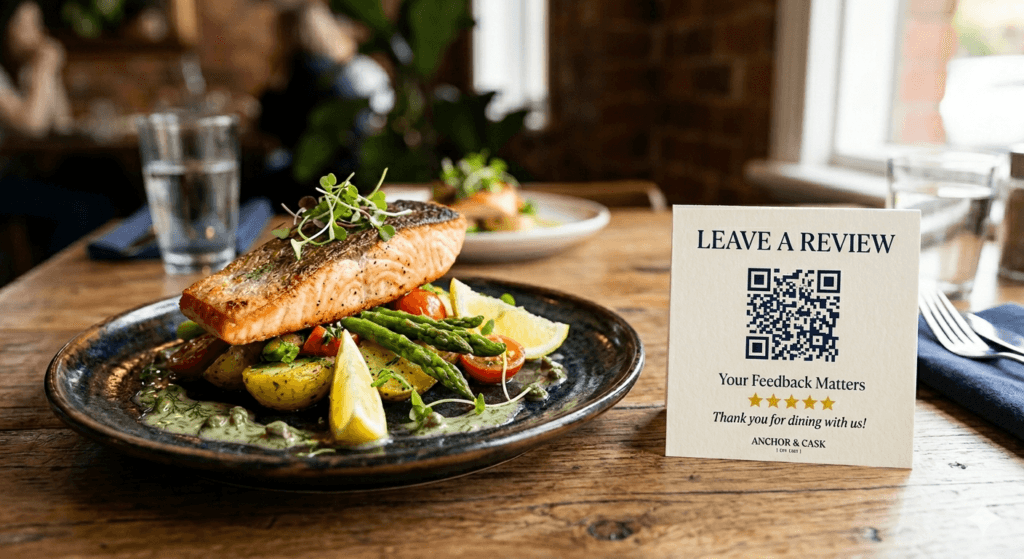
The easiest way to reduce friction is a Google review QR code – a small code that takes guests directly to your review page when they scan it with their phone. No searching, no extra steps. Just a tap and they’re there.
You can place it on:
- The back of your menu
- A small card on the table or in the bill folder
- Your receipt or thank-you card after a booking
- A sign near the exit or at the counter
The goal is to remove every possible obstacle between a happy guest and a completed review. If it takes more than 10 seconds to get to your review page, you’re losing people.
I’ve written a simple guide on how to create and place a Google review QR code for your restaurant – it takes about five minutes to set up.
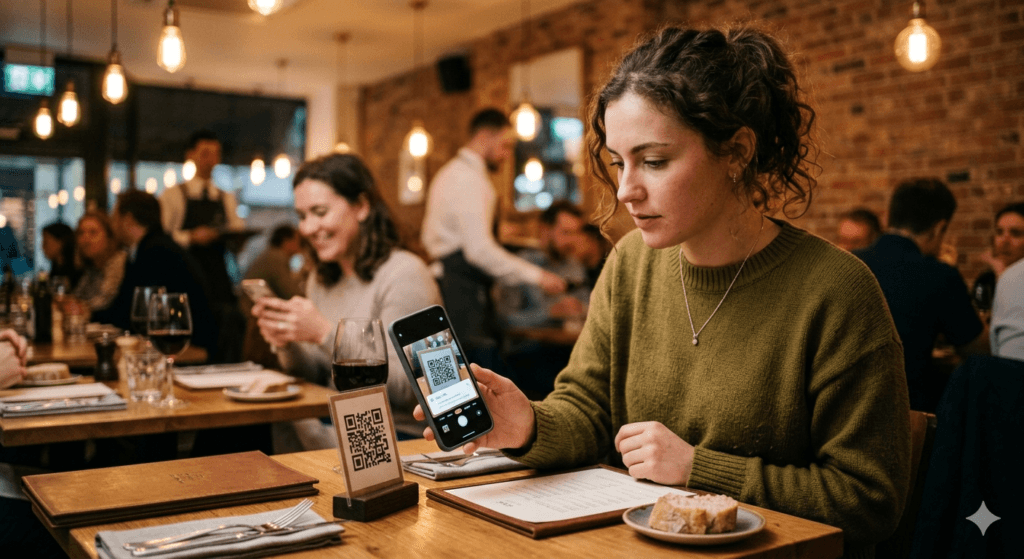
2. Ask at the Right Moment
Timing matters more than the words you use.
The best moment to ask for a review is when a guest has already expressed something positive — they’ve complimented the food, smiled at the server, or said “we’ll definitely be back.”
That’s the moment. Not at the end of every table. Not in a scripted way that feels like a corporate prompt. Just naturally, in response to something real.
It might sound like:
“That’s so lovely to hear – if you ever get a chance to leave us a review on Google, it genuinely means a lot to a small restaurant like ours.”
That’s it. Simple, human, and said at the right moment.
I’ve written a full guide on how to ask for Google reviews without sounding pushy – including timing, specific phrases, and what to avoid.
3. Keep It Consistent, Not Occasional
One of the biggest mistakes I see is treating reviews as something you focus on now and then – usually when you notice your count is low or a competitor pulls ahead.
That approach creates uneven bursts, and Google notices. A profile that gets 15 reviews in a week and then nothing for three months doesn’t look as healthy as one that receives two or three reviews consistently every week.
Consistency matters because recent reviews matter.
Why recency matters: A guest scanning your profile in April doesn’t really care that you had great reviews in October. They want to know that people are eating at your restaurant now and enjoying it. Recent reviews answer that question. A large but stagnant count doesn’t.
The goal isn’t a campaign. It’s a quiet habit – a small, steady flow of real feedback that keeps your profile feeling alive and current.
4. Respond to Reviews Thoughtfully
Getting reviews is only part of the picture. How you respond to them matters too — and it influences future guests more than most restaurant owners realise.
When someone reads your reviews, they’re not just reading what guests said. They’re watching how you responded.
- A warm, genuine reply to a positive review tells future guests: this team cares about its guests
- A thoughtful response to a critical review tells them: this restaurant handles things with grace
- Responding at all signals to Google that your venue is active and engaged
Responses don’t need to be long. They just need to feel like a real person wrote them — not a copy-paste template.
Even the way your business is described influences how guests interpret reviews. A clear, honest profile sets the right expectation before they even read feedback.
→ Read more: How to Write a Google Business Profile Description That Gets More Bookings
How to Ask for Google Reviews Without Feeling Awkward
For many hospitality teams, the asking part is the hardest. It can feel uncomfortable — like you’re putting a guest in an awkward position, or making the end of their meal about you rather than them.
A few things that help:
Make it personal, not procedural
There’s a big difference between a waiter robotically saying “please leave us a review” and a genuine moment of connection where someone says it naturally as part of a real conversation.
Don’t ask every table
Ask the tables that have already shown you they’re happy. It’s a warmer conversation, and it works better.
Keep the ask light
You’re not asking for a favour. You’re giving a guest a way to support something they already enjoyed. That’s a different feeling entirely.
I’ve written a full guide on this – Get More Google Reviews Without Awkward Asking– which goes deeper into language, timing and what to avoid.
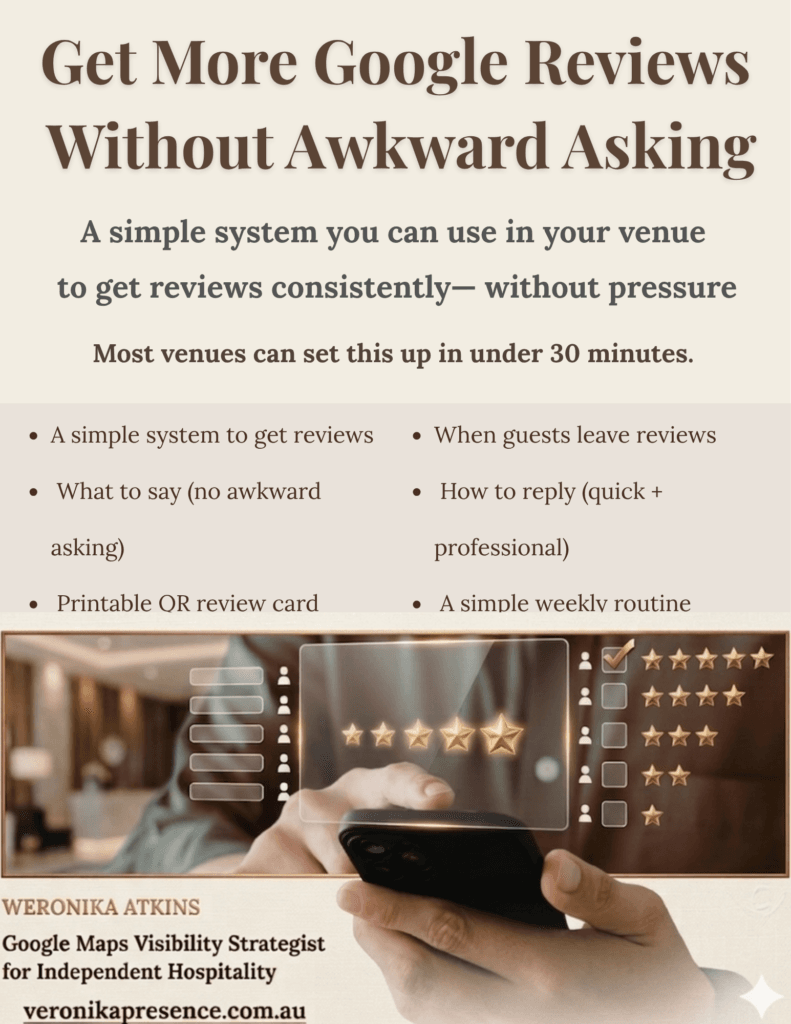
How Many Google Reviews Does a Restaurant Need?
This is one of the questions I hear most often. Honestly – there’s no magic number.
| What matters less | What actually matters |
|---|---|
| A large total review count | ✓ Consistent, steady flow of new reviews |
| Hitting a specific number | ✓ Recency — reviews from the past few weeks |
| A one-off push to get 50 reviews fast | ✓ A quiet habit that keeps reviews coming in |
| 400 reviews with the last one 6 months ago | ✓ 80 reviews with 3 added this week |
The goal is to get to a place where your review count is growing slowly and steadily – where there’s always something recent for a guest to land on when they’re deciding whether to visit.
Common Mistakes That Stop Restaurants Getting Reviews
🔲
No QR code or direct link
Guests are willing, but the path is too long. They give up before they get there.
⏱
Asking at the wrong moment
Mid-conversation at the door isn’t the right moment. The energy has already shifted.
📉
Treating it as one-off effort
A burst of reviews after a push, then nothing. The profile looks uneven and momentum doesn’t hold.
🔇
Not responding to reviews
Ignoring reviews – positive or negative – signals that no one is paying attention to the profile.
👥
Asking all guests equally
Not every table is the right table. Reading the room is part of getting it right.
📋
Using scripted language
Guests can tell when something is rehearsed. Natural and specific always works better.
If you’d rather not piece this together yourself, I’ve created a simple step-by-step guide covering exactly what to fix first on your profile – including reviews, photos, and key details.
→ Fix Your Google Business Profile in 30 Minutes
A Simple System to Get More Google Reviews (Without Stress)
What I try to help restaurants build is something small enough to actually use.
Not a complicated strategy. Not a software subscription. Just a clear, simple approach that fits into the rhythm of a real hospitality business – where the focus is on service, not admin.
A good review system typically involves:
- A QR code that’s easy to scan and correctly placed
- A short, natural phrase that feels comfortable to say
- A moment in service where it makes sense to say it
- A weekly habit – not an occasional push
Most of this can be set up in under 30 minutes. And once it’s in place, it runs quietly in the background — building a steadier, more consistent review count without anyone needing to think about it too hard.
If you’d like a simple, step-by-step system you can put in place this week. -👉 Google Reviews for Cafés, Restaurants and Wineries
When to Get Help with Google Review Management
Sometimes the issue isn’t just reviews – it’s the whole profile.
If you’ve been in business for a while but your review count feels too low for the guests you’re actually serving, it’s usually a sign that a few things need attention at once. The profile might be missing some trust signals, the photos may not be reflecting the real experience, or there’s simply no consistent rhythm to how the profile is being maintained.
Check: Restaurant Review Management in Melbourne
These things are hard to see from the inside when you’re running a restaurant. From the outside — as someone who looks at hospitality profiles regularly – they’re usually visible within a few minutes.
If your profile feels inactive, your reviews have slowed down, or you’re not sure what guests are seeing when they compare you to other venues nearby, a fresh set of eyes can help.
👉 Request a free visibility check
Frequently Asked Questions
How do I get customers to leave Google reviews?
The most effective approach is to make it as easy as possible – a QR code or direct link that takes guests straight to your review page – and to ask at the right moment, when a guest has already expressed that they enjoyed the experience. Consistency matters more than a one-off push. A few reviews coming in steadily each week will always outperform an occasional burst.
Is it okay to ask for Google reviews?
Yes, absolutely. Google’s guidelines permit businesses to ask guests for reviews. The only thing they don’t allow is incentivising reviews – offering discounts, free items, or anything in exchange for a positive review. Asking genuinely and naturally is completely fine, and in most cases, guests are happy to help when it’s done well.
Can I use a QR code for Google reviews?
Yes – and it’s one of the most practical things you can set up. A Google review QR code links directly to your review page, removing the friction of guests having to search for your venue manually. You can generate one through your Google Business Profile and place it anywhere guests are likely to scan – menus, table cards, receipts, or near the exit.
Why are my customers not leaving reviews?
Usually, it comes down to timing and friction. Guests don’t leave reviews because it doesn’t occur to them at the right moment, or because the process feels like too many steps. If you’re not actively making it easy – and gently prompting at the right time – most happy guests will simply move on with their day. It’s not a reflection of how much they enjoyed themselves.
Weronika Atkins works with cafés, restaurants and wineries across Victoria, helping venues appear clearly and confidently on Google Maps. Learn more about her approach to hospitality visibility.
Google Review QR Code for Restaurants: Simple Setup That Works
Weronika Atkins / April 1, 2026
Struggling to get Google reviews? A simple QR code can make it effortless for your guests. Here’s how to set it up and use it naturally in your restaurant.

Pingback: Google Review QR Code for Restaurants: Simple Setup That Works
Pingback: How to Ask for Google Reviews Without Sounding Pushy (Restaurant Guide)
Pingback: Why Your Restaurant Isn't on Google Maps? And How to Fix It Fast