Why 4.3 Stars Can Beat 4.8 on Google Maps (For Cafés, Restaurants & Wineries)
Picture this. Someone is standing on a street corner on a Sunday afternoon, phone in hand, trying to decide where to go for lunch. They open Google Maps. Two cafés appear side by side. One has 4.8 stars. The other has 4.3 – but 340 reviews, the most recent posted four days ago.
Which one do they choose?
If you said the 4.8, you wouldn’t be alone. Most people assume the higher number wins. But research into how guests actually behave on Google Maps tells a more interesting story – and understanding it could quietly change how you think about your venue’s profile.
And increasingly, that decision is happening before they’ve even opened a profile – shaped not just by what they see, but by how Google now interprets reviews and presents venues to them.
This isn’t based on theory – it’s based on how guests actually behave on Google Maps across hundreds of hospitality profiles.
What guests actually see in those first ten seconds
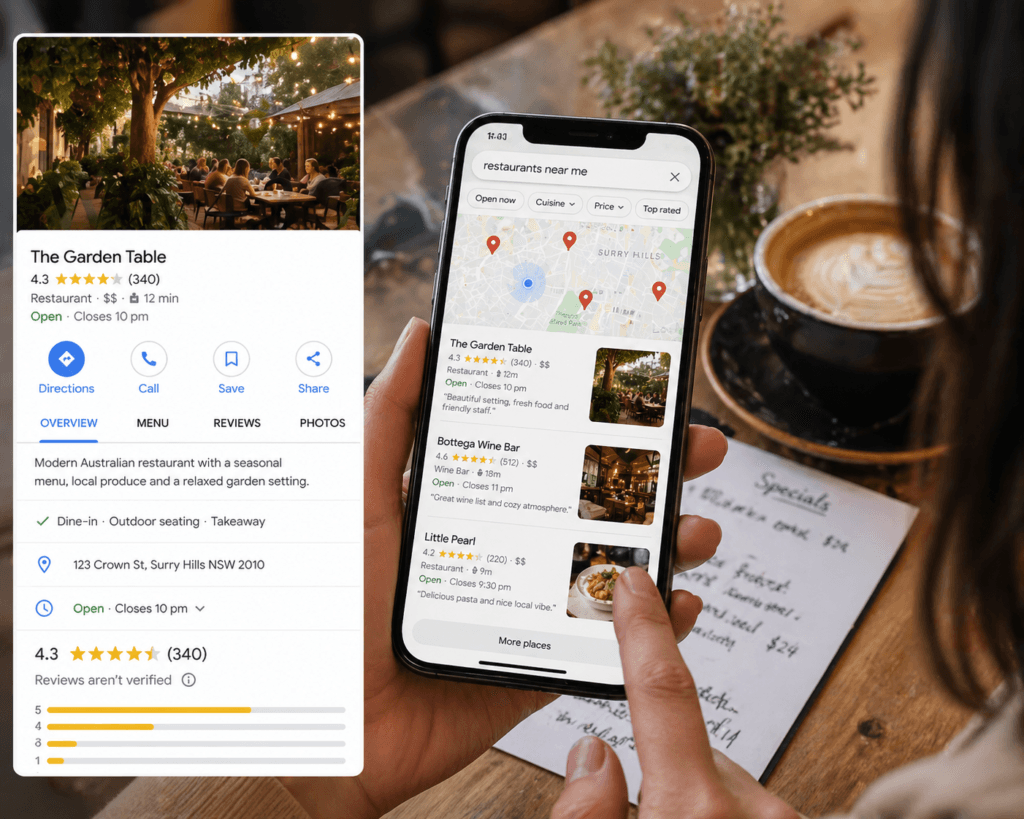
When someone opens Google Maps to find a restaurant, café or winery, they’re not reading carefully. They’re scanning. And they’re usually comparing two or three options at the same time.
In those first ten seconds, their eyes pick up a few things at once: the star number, the review count, the date of the most recent review, and the photos. They’re not consciously analysing any of it. They’re just forming a feeling – does this place seem good? Does it seem worth trying?
The star rating matters. But it’s only one piece of what creates that feeling. Look at how differently these two profiles read:
What most venues misunderstand about ratings
Profile A
⭐4.8
12 reviews
Last review: 8 months ago
Profile B
⭐4.3
340 reviews
Last review: 4 days ago
More bookings
This is why a 4.3 with strong, recent reviews often outperforms a higher rating.
a handful of people loved it. That’s a much smaller proof point.
Nearly 94% of diners base their dining decisions on online reviews – treating them almost like a word-of-mouth recommendation from a stranger. What they’re looking for isn’t a perfect number. They’re looking for evidence.
The Trust Sweet Spot – And Why a Perfect Score Can Actually Work Against You
This is the part that surprises most venue owners: a 5.0 rating can sometimes make guests less likely to book, not more.
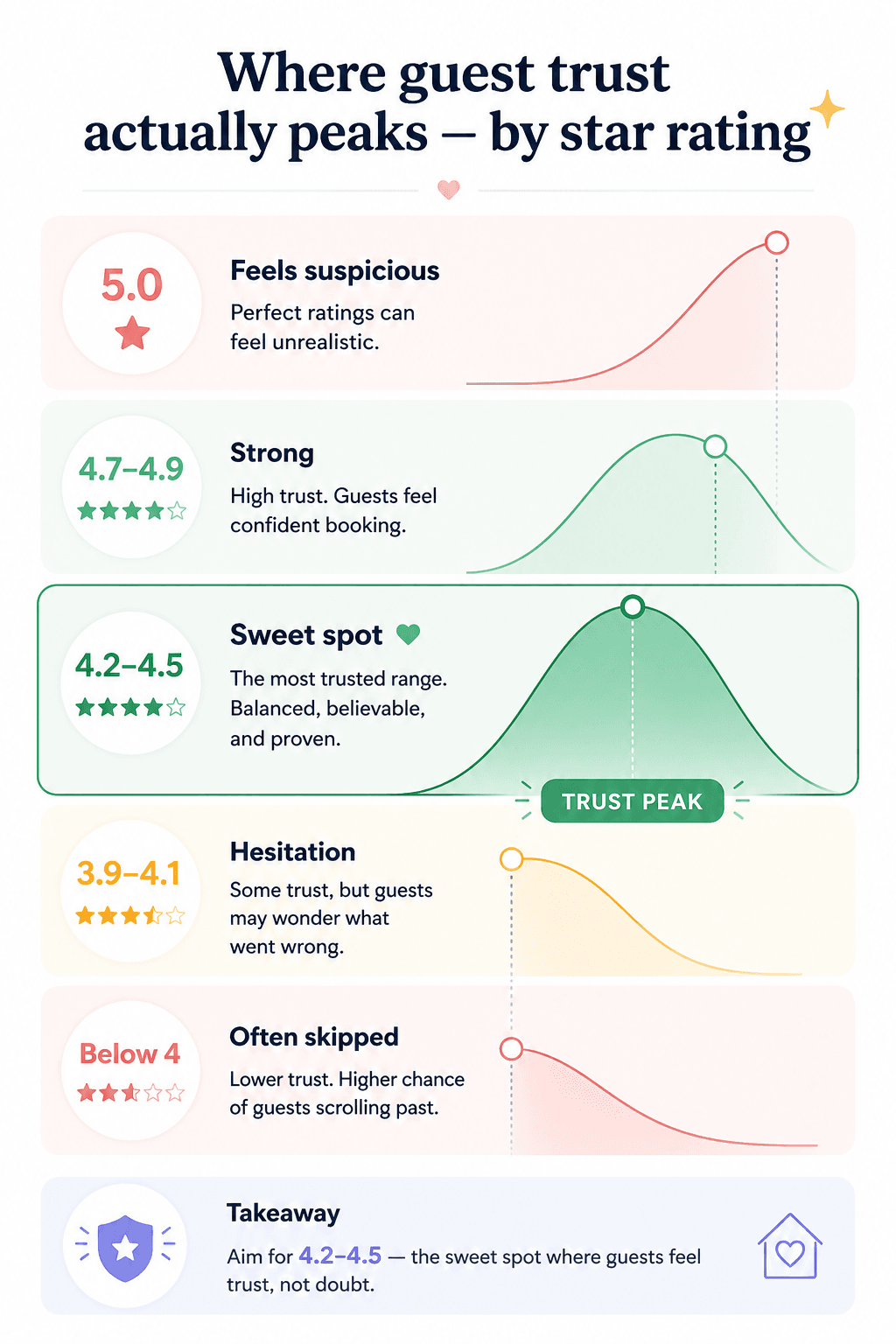
Research from Northwestern University’s Spiegel Research Center found that a perfect five-star average can actually reduce trust. The reason is simple – perfection doesn’t feel real. When every single review is five stars, something in our brain quietly wonders whether the reviews are genuine, or whether critical feedback is being filtered out.
For hospitality venues especially, this makes a lot of sense. A café or restaurant with 500 reviews and a 4.9 average can feel curated – almost too polished to trust. A winery with 4.4 and a mix of warm, specific reviews feels like somewhere people are genuinely excited to tell others about.
Remember: The goal isn’t a number. It’s a profile that feels believable.
Review count matters more than most owners realise
The number in brackets next to your star rating is doing an enormous amount of work.
Volume signals trust. It tells a guest that people actually come here, that the venue has been around long enough to accumulate real feedback, and that the rating isn’t based on a handful of visits from regulars.
59% of customers only trust a star rating if there are more than 20 reviews to back it up
In the restaurant and café category, the benchmark is even higher – venues typically average several hundred reviews, simply because food experiences naturally prompt feedback.
What this means in practice: if your café has 18 reviews and a 4.9, a competitor with 180 reviews and a 4.3 is almost certainly appearing above you in local search results – and converting more guests once they land on the profile.
If you’re thinking about how to start building that volume, this guide on getting more Google reviews for restaurants walks through practical steps without making it feel like extra work on top of an already full day.
The signal guests are really scanning: recency
If there’s one thing that gets overlooked more than anything else, it’s the date of the most recent review.
Guests don’t read every review. Most of the time, they look at the overall rating, scroll briefly through a few of the recent ones, and check how long ago the last review was posted. That date does a surprising amount of work.
73% of consumers don’t trust reviews older than one month
A review from ten months ago carries a quiet sense of uncertainty. Has anything changed? Is this place still as good? A review from four days ago feels current – the venue is active, guests are still going, the experience is still worth talking about.
Think of two wineries sitting alongside each other on Google Maps. Same rating – 4.6.
Winery A‘s most recent review was posted eleven months ago.
Winery B‘s was posted three days ago. The guest doesn’t consciously process this. They just feel more confident in one.
And they choose Winery B.
This is why a steady, consistent flow of reviews matters more than a burst of activity followed by silence. Not dozens every week – just a gentle, ongoing rhythm that tells Google and guests alike that your venue is alive and worth choosing right now.
What a negative review can actually do for your venue
Here’s the counterintuitive one – and one of the most useful things to understand about how guests read reviews.
A negative review, handled well, can actually build trust.
When someone is considering a venue they’ve never visited, they often seek out the lower-rated reviews first. Not because they’re looking for reasons not to go – but because they want to understand what the realistic experience looks like, and how the owner responds when something goes wrong.
What a calm response communicates:
A thoughtful reply to a 3-star review signals something no number of five-star responses can: there’s a real person running this place, and they care. It tells future guests that if they ever have an issue, it will be taken seriously.
Businesses that respond to their reviews earn measurably more revenue than those that don’t. And responding to a negative review specifically can neutralise its effect – not erase it, but put it in a context that makes it far less damaging. Ignoring a negative review doesn’t make it disappear. It just sits there, unanswered, quietly telling every future guest that the owner either didn’t notice or didn’t care.
For a deeper look at how to handle reviews in a way that builds rather than deflects trust, this guide on restaurant review management covers the practical side.
At a glance – what guests are actually reading
| What they see | What it says to them |
|---|---|
| 4.8 stars, 11 reviews | Looks promising – but not enough people have been here yet hesitation |
| 4.3 stars, 340 reviews | Popular and well-visited — this feels like real social proof trust |
| Last review: 9 months ago | Has something changed? Is it still as good? doubt |
| Last review: 4 days ago | This place is busy and current – worth visiting confidence |
| No responses to reviews | The owner isn’t really paying attention concern |
| Warm responses to reviews | Someone who cares is running this place trust |
What this means for your venue right now
None of this is about gaming a system. It’s about understanding how the people you most want to reach are actually making decisions – and making sure your profile is working with that, not against it.
✔️ Pay attention to the full picture, not just the number
The star rating, review count, recency, photos, and responses – all of it combines into a first impression that guests form in about ten seconds. Each element matters.
✔️ Stop optimising for a perfect score
A consistent, genuine 4.3 or 4.5 – backed by a healthy volume of recent reviews – will serve you far better than a polished 4.9 built on twelve reviews that haven’t grown in months.
✔️ Think about recency as much as rating
Keep a steady flow of new reviews coming in. Not a flood – just consistency. A review every few days makes a meaningful difference to how current and active your venue feels.
✔️ Respond to your reviews – especially the difficult ones
Acknowledging what guests say, thanking them, and addressing concerns calmly is one of the quietest and most effective trust-building tools available to you.
The guest on the street corner
Back to that Saturday lunch decision. Two cafés, side by side. One at 4.8, one at 4.3 with 340 reviews and a response from the owner under every single one.
The guest chose the 4.3.
Not because they analysed the data. Not because they read every review. But because in ten seconds of scanning, that profile felt more real, more current, and more trustworthy. It felt like somewhere people actually go – and keep going back to.
That’s the environment your Google Business Profile lives in. Not a directory listing that people read carefully. A decision-making moment that happens fast, on a phone, against three other venues showing up at the same time.
Understanding how that moment works is the first step to making sure your venue is the one guests choose.
New in 2025–2026
Google AI updates
Google is now reading your reviews for you – and telling guests what they say (Google AI)
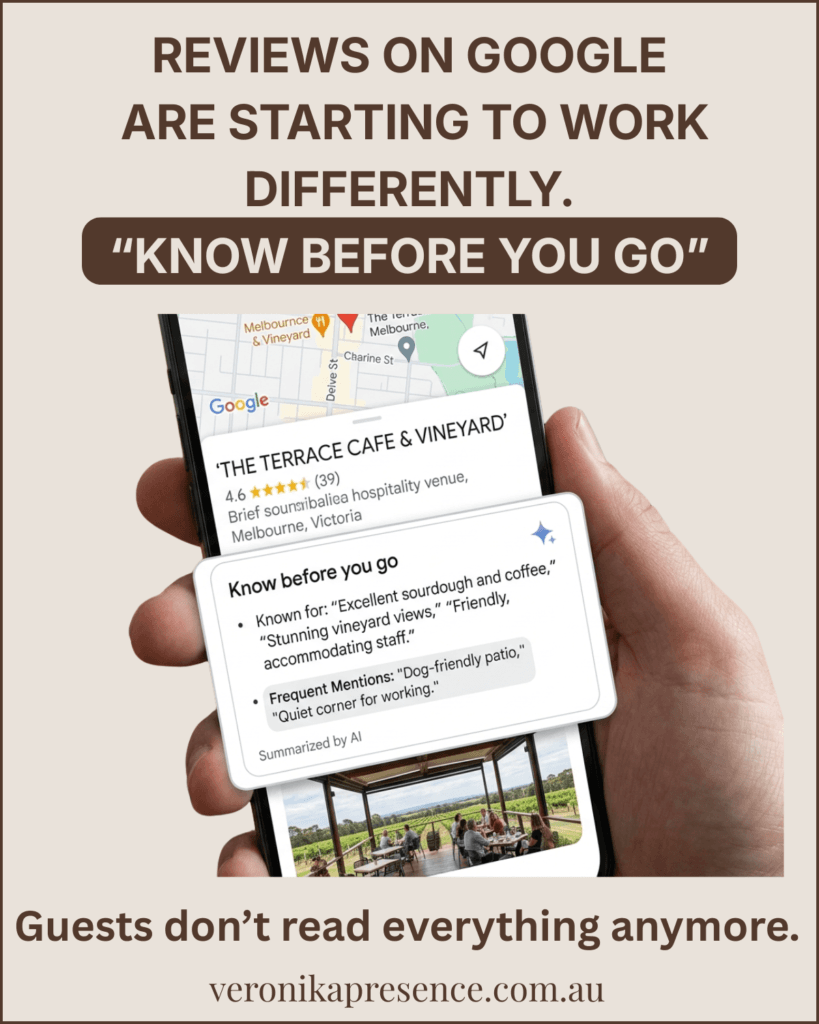
There’s another layer to all of this – and most venue owners haven’t fully noticed it yet.
Google is no longer just displaying your reviews. It’s reading them.
What’s happening on your profile now
- Google scans your reviews using AI
- It pulls out patterns and key details
- It shows them directly to guests
Sometimes as:
- short summaries
- “Know before you go” tips
- highlighted experiences (food, atmosphere, service)
A guest can now form an impression without reading a single review
What Google is actually looking for
It builds that impression from what guests write.
| If your reviews say… | Google understands… |
|---|---|
| “Nice place, good food” | Nothing specific to show |
| “Wood-fired pizza, outdoor terrace, dog-friendly garden” | Clear, compelling experience |
👉 The more specific and descriptive the review
👉 the stronger the story Google can tell
Reviews are no longer just for guests. They are now: input for how Google describes your venue
And this affects whether you get chosen at all
Search is changing.
Guests now type things like:
- “quiet winery for the weekend”
- “café with outdoor seating and good coffee”
Google reads your:
- reviews
- profile
- activity
…and may recommend: 👉 one venue. Not a list.
So the real question becomes
It’s no longer:
Do you have good reviews?
It’s:
What story do your reviews allow Google to tell about you — right now?
What strong profiles have in common
- steady flow of recent reviews
- specific, experience-based language
- clear and consistent positioning
These profiles give Google confidence
What weaker profiles feel like
- older reviews
- vague wording
- gaps in activity
These profiles feel uncertain – and often get skipped
The quiet shift
Your reviews are no longer just being read by people. They are being: and presented before a guest even clicks, summarised, interpreted.
This is also why profiles that are actively managed – with consistent reviews, clear information, and regular updates – tend to be the ones that continue to show up and get chosen.
If you’d like to understand how your venue’s profile currently reads – not just to guests, but to Google’s AI – a free visibility check looks at the full picture. I help your venue be chosen – before a guest even opens your profile.
Google is no longer just showing your reviews – it’s interpreting them.
And the clearer, more consistent your review profile is, the easier it becomes for Google to confidently recommend your venue.
FAQ
What is actually a good Google star rating for a restaurant or café?
The national average across Google sits around 4.1–4.3 stars, but restaurants and cafés tend to cluster higher because people are more motivated to review food experiences. In practice, 4.2 to 4.5 is the sweet spot – it’s where guest trust peaks and conversion (someone going from browsing to actually visiting) is highest.
A 4.9 or 5.0 can actually work against you — it starts to feel curated rather than genuine, and some guests will wonder if lower reviews are being hidden. A 4.3 with 300 real reviews is a stronger trust signal than a 4.9 with 14.
The most trusted range according to research: 4.2–4.5 stars. This is where purchase intent peaks – not at 5.0.
Does my star rating actually affect how often I show up on Google Maps?
Yes – directly. Google’s local ranking algorithm uses review signals (rating, review count, recency, and review text) as one of its key inputs. Higher-rated profiles with more reviews tend to appear in the Local Pack (the top 3 map results) more often than lower-rated ones, even if they’re slightly further away geographically.
There’s also the filter effect: when guests tap “4 stars & up” in Google Maps — which many do — anything below that threshold disappears entirely from their results. You don’t just rank lower; you vanish.
Review signals account for an estimated 20% of Google’s local ranking algorithm. That’s significant.
How many Google reviews does my venue actually need?
There’s no magic number, but there are useful benchmarks. 59% of people won’t fully trust a rating with fewer than 20 reviews. For restaurants and cafés specifically, the competitive bar is much higher — top-ranking local venues typically hold 100–500+ reviews.
The most honest answer: you need more reviews than your nearest competitors. If the café two doors down has 200 reviews and you have 40, that gap is doing real work against you — in both rankings and in the way guests perceive you.
More importantly than hitting a number, focus on consistency — a steady trickle of new reviews over time signals to both Google and guests that your venue is active and current. See: how to build review volume without it feeling like work.
One bad review came in. How much it will hurt my rating?
Less than you think — if you have a reasonable volume of reviews already. A single 1-star review landing on a profile with 150 reviews will move your average by a fraction. On a profile with 8 reviews, it can knock you from 4.8 down to 4.2 overnight.
This is one of the strongest arguments for building review volume consistently. The more real reviews you have, the more resilient your rating is to any single bad experience.
One restaurant in Chicago received 15 fake one-star reviews overnight. After Google removed them, they calculated they’d need nearly 160 five-star reviews just to recover the fraction their rating had dropped. Volume is armour.
What matters more than the rating movement is how you respond. A thoughtful, calm reply to a negative review is read by every future guest who sees that review — and it tells them something the five-star reviews can’t.
Should I respond to every review – including the positive ones?
Yes – and it’s worth understanding why. 97% of people who read reviews also read the owner’s responses. Your responses aren’t just for the reviewer – they’re performing for every future guest who lands on your profile.
For positive reviews: a warm, specific reply (not a copy-paste thank you) reinforces that there’s a real person running the place. Mentioning the guest’s name, or something specific from their review, takes 30 seconds and reads entirely differently to a generic response.
For negative reviews: respond calmly, acknowledge the experience, and offer to continue the conversation offline. Never be defensive. The goal isn’t to win an argument – it’s to show the next 500 guests who read that thread who you are as an owner.
Businesses that respond to reviews earn measurably more revenue than those that don’t. Aim to respond within 24–48 hours. For more guidance: restaurant review management that builds trust.
Can I remove a negative review from Google?
Not directly – and it’s important to know this clearly so you don’t waste energy on it. Google does not allow businesses to delete genuine reviews. You can flag a review for removal if it genuinely violates Google’s policies (spam, fake account, personal attacks, off-topic content), but Google makes the final call, and the process can be slow.
If a review is fake or part of a coordinated attack, Google has a Merchant Extortion form specifically for that situation — it escalates the issue faster than a standard flag.
One thing worth knowing: deleting your Google Business Profile does not delete the reviews. They stay attached to the location. You’d lose all ability to respond while the reviews remain visible. Don’t do this.
The practical approach: respond well, then focus energy on generating more genuine positive reviews. If you have 200 real reviews, a handful of questionable ones loses most of its power.
How quickly does my Google rating update after new reviews come in?
Google states that after a new review is submitted, it can take up to two weeks for the average rating to visibly update. In practice it’s often faster – sometimes within a day or two – but don’t expect immediate movement.
This is worth knowing when you’re actively trying to recover a rating after a difficult patch. The results of your effort won’t be instantaneous. Keep going steadily rather than trying to generate a burst of reviews all at once — a sudden spike can actually trigger Google’s spam filters and get legitimate reviews held back.
Can I ask my customers to leave a review? Is that allowed?
Yes – and you should. Asking for honest feedback is completely within Google’s guidelines. What isn’t allowed is incentivising a positive review specifically (offering a free drink only in exchange for five stars, for example). You can offer a gesture that applies to anyone who leaves any kind of review, but coaching people toward a specific rating crosses a line Google takes seriously.
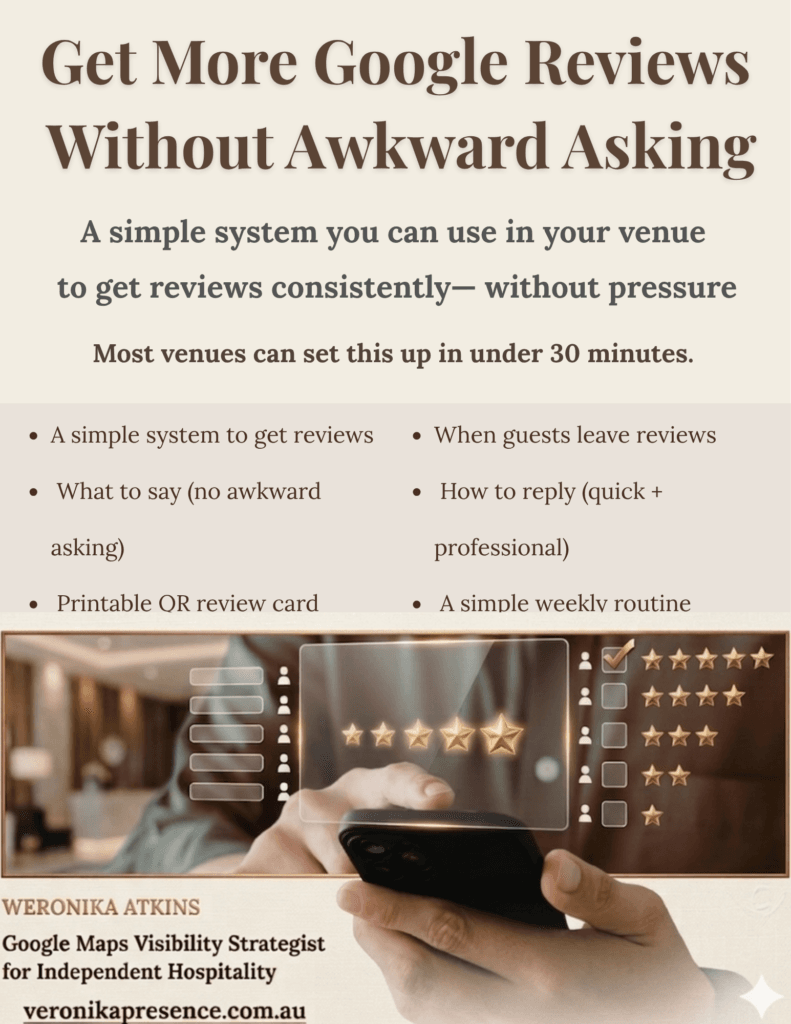
The most effective ask is simple, personal, and timed well – at the moment a guest is clearly happy, not as they’re rushing out the door. A QR code on the receipt or table is a frictionless way to make it easy without it feeling like a demand. See: how to use a review QR code at your venue.
Never ask for “a five-star review.” Always ask for “honest feedback.” Google’s algorithm can detect coaching patterns, and it damages your credibility with guests too.
My reviews have gone quiet – we haven’t had new ones in months. Does that hurt our restaurant?
Yes – in two ways. First, Google weights recency heavily. A profile with no new reviews in six months sends a quiet signal that the venue may have changed, gone quiet, or dropped in quality. 73% of guests don’t trust reviews older than a month.
Second, competitors who are actively generating fresh reviews will gradually outrank you in local search, even if their overall rating is lower. Recency matters to the algorithm, not just the number.
The good news: this is fixable without a big marketing effort. A consistent, low-key system for prompting reviews — QR codes, a post-visit message, a word at the right moment — can restart the flow steadily. It doesn’t need to be a campaign. It just needs to be a habit. Start here.
I think a competitor left fake negative reviews on my profile. What do I do?
It happens – and it’s more common than most owners realise. If you suspect a coordinated attack (multiple one-star reviews arriving quickly, with no photos, no review history, and bizarre or off-topic content), act quickly:
Flag each review using the “Report a problem” option – be specific about why it violates policy (fake account, not a real customer, spam).
If you believe you’re being extorted (someone asking for payment to remove reviews), use Google’s Merchant Extortion form – this escalates the issue directly and gets faster attention than a standard flag.
Don’t retaliate – leaving fake positive reviews to compensate will likely trigger Google’s spam detection and cause your legitimate reviews to be filtered out too.
The long-term protection is volume. A profile with 300 genuine reviews is far harder to damage than one with 30. Ten suspicious one-star reviews barely move the needle on a profile with that foundation.
Does it matter whether reviews have photos or just text?
It matters a lot – both for guests and for Google. Reviews with photos get highlighted prominently in Google Maps, often appearing in the photo gallery of your profile without the owner needing to upload them. Guest-taken photos carry real trust weight because they feel unfiltered and real.
Reviews with detailed text – mentioning specific dishes, the atmosphere, the service – are also more useful to the algorithm. They signal relevance for specific searches (“best brunch in [suburb]”, “winery with dog-friendly cellar door”) and help Google understand what your venue is actually known for.
A star-only review still counts toward your volume and rating, but a review that says “the mushroom toast was incredible and the staff remembered our anniversary – we’ll definitely be back” is doing substantially more work for your visibility and your guests’ confidence.
I am not sure where my venue even stands on Google right now. Where do I start?
A good first step is simply looking at your profile the way a guest would – open Google Maps, search your venue name, and spend ten seconds on your profile as if you’d never seen it before. What do you notice? What’s the most recent review date? How does it compare to the venue next to you in search results?
If you’d like a more structured look – one that goes beyond the rating and looks at photos, completeness, competitive positioning, and what’s likely causing hesitation – a free visibility check is a good place to start. It gives you a clear picture of how your profile currently reads to guests who are deciding in real time.
Want to understand how your café, restaurant or winery currently appears on Google Maps? A free visibility check gives you a clear picture – no commitment, just a quiet look at what guests are seeing.
And if you’re working on building your review presence, these two guides are worth reading alongside this one: